
Each section names the problem, the idea in one line, what you will be able to do, and the method from the book.
1. Choose the customer you serve best
The problem: Customers can't tell you apart, so they choose on price.
You can sell to anyone who walks in, but aim at the customers you serve best. A clear target makes every message sharper.
By the end of the chapter you can:
- Score past customers on profit, fit, ease, delight and referrals
- Write a one-page sketch of your target customer
- Name the trigger that makes them start looking
Find your best customers in your own records
Your best customers are already in your records. Take your last 30 to 60 customers or jobs and score each one on five things, using simple marks: 1 for poor, 2 for average, 3 for good.
| Score | The question | Where to find the answer |
|---|---|---|
| Profit | Did we earn a good margin on this job? | Job costing, invoices |
| Fit | Did our strengths matter to this customer? | Your team's memory, feedback |
| Ease | Few changes, disputes and late payments? | Site notes, collections record |
| Delight | Were they clearly happy? | Reviews, repeat work, messages |
| Referrals | Did they send others to us? | Your “how did you hear about us?” notes |
Then group the customers by type, meaning who they are and what they needed, and add up each group's scores. One or two groups usually stand out on profit and delight at the same time. That is where to aim.
2. Pick your platforms
The problem: You post regularly and get likes, not enquiries.
Be excellent on one main platform and present on one supporting platform, and build a list of customers you own.
By the end of the chapter you can:
- Choose a main and a supporting platform for your business
- Set up a profile that turns visits into enquiries
- Start a list of customers you can reach directly
The main platforms at a glance
A rough guide to what each platform is good at for a growing Indian business. Your own customers' answers matter more than any general rule.
| Platform | Good for | Content that works | Effort |
|---|---|---|---|
| Consumer brands, local services, food, design, fitness | Short videos, photos, stories | Medium to high | |
| YouTube | Explaining, teaching, comparing; being found by search | Longer explainers, plus short videos | High |
| Older audiences, local communities, groups | Videos, posts, community groups | Medium | |
| B2B, professional services, hiring, senior buyers | Written posts, insights, case stories | Medium | |
| Existing customers and warm leads | Updates, offers, status, catalogues | Low to medium | |
| Google Business Profile | Local businesses found on search and maps | Photos, updates, replies to reviews | Low |
3. How the ad system decides who sees your ad
The problem: You spend on ads and can't see what they bring in.
You choose the goal, the budget and the ad; the system chooses who sees it. Give it a clear goal and enough results to learn from.
By the end of the chapter you can:
- Explain how the auction picks ads
- Set up a simple, clean campaign structure
- Choose a goal and a starting budget the system can learn from
Campaign, ad set, ad
Every account has three levels. Keeping them tidy is half of running ads well.
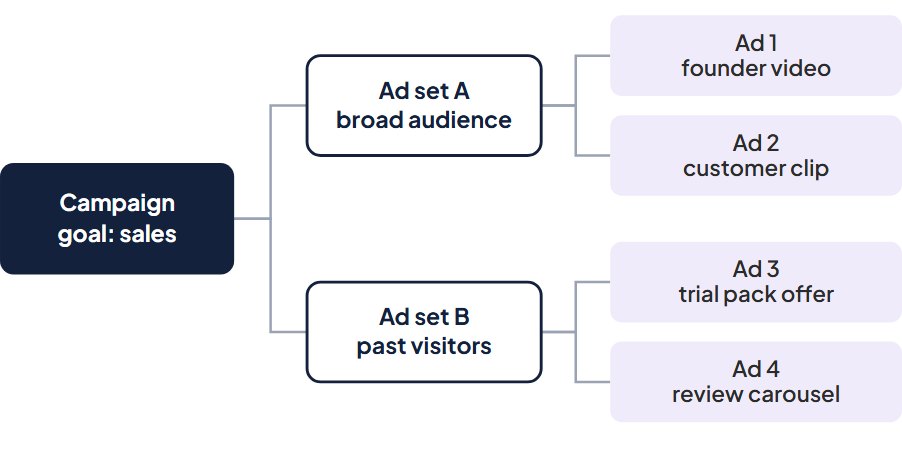
| Level | What you decide here |
|---|---|
| Campaign | The goal (sales, leads, messages) and often the budget |
| Ad set | Who (audience, location, age), where (placements), when, and sometimes the budget |
| Ad | What people see: image or video, words, headline, button, link |
4. Your Google Business Profile: the free shop window
The problem: Customers search for what you sell and find someone else.
Your free Google profile is often the first thing a local customer sees. Complete, accurate and active profiles get the calls.
By the end of the chapter you can:
- Set up every important part of your profile
- Keep it active with photos and posts
- Avoid the mistakes that get profiles suspended
Set it up properly
Claim and verify your profile, then fill in each part as below. Accuracy matters more than anything.
| Part | Do | Don't |
|---|---|---|
| Business name | Exactly as on your signboard and documents | Add keywords: “Best AC Repair Ahmedabad Cheap” |
| Main category | The one that best describes your core service | Pick a broad category to show up more |
| Extra categories | Only those you genuinely offer | Add every loosely related category |
| Address or service area | Your real address; or areas you serve if you visit customers | Fake addresses or virtual offices |
| Hours | Real hours, including special and holiday hours | “Open 24 hours” unless you are |
| Phone and website | A number that's answered; the most relevant page | A number nobody picks up |
| Services and description | Customer words, services, areas, what makes you different | Keyword lists |
5. A profile that answers “why you?”
The problem: Your profile and network never turn into work.
Your profile is your landing page. In a few seconds it must tell the right people what you help with, prove it, and invite them to talk.
By the end of the chapter you can:
- Write a headline that speaks to your buyers
- Write an About section in four parts
- Add proof and a clear next step
A headline that says what you help with
Your headline appears with your name everywhere: in search, comments, messages and posts. It's the most read part of your profile. Make it about the people you help.
6. Set it up properly: profile, catalogue, labels
The problem: Enquiries reach you on WhatsApp and then slip away.
A complete business profile, a clean catalogue and a simple labelling system turn a chat app into an organised shop.
By the end of the chapter you can:
- Complete every part of your business profile
- Build a catalogue that answers questions before they're asked
- Track every chat with labels
A catalogue customers can browse
A catalogue lets customers see your products, prices and details inside the chat. Done well, it answers half the questions before they're asked.
- Good photos: natural light, plain background, the product clearly, several angles.
- Clear names and codes: “Kanjivaram silk, maroon · KH-214”, so customers can refer to items.
- Prices and key details: price, fabric, size or measurements, what's included, delivery time.
- Group into collections: festive, daily wear, under ₹2,000, new arrivals.
- Keep it current: remove sold-out items the same day; nothing annoys like “sorry, sold out”.
7. Know who buys again: a simple customer list and groups
The problem: You keep paying to win customers who buy only once.
You can't keep customers you can't see. A simple list with three facts per customer, when they last bought, how often and how much, shows you who to thank, who to remind and who to win back.
By the end of the chapter you can:
- Build a customer list from your own records
- Sort customers into five groups
- Choose the right action for each group
Three facts: recent, frequent, valuable
Three facts about each customer predict who is likely to buy again: how recently they bought, how often they buy and how much they spend. Marketers call this RFM.
| Fact | Question | Why it predicts buying |
|---|---|---|
| Recency | When did they last buy? | People who bought recently are most likely to buy again |
| Frequency | How many times have they bought? | Habits continue |
| Monetary value | How much have they spent? | Big spenders are worth more attention |
You don't need complex scoring. Simple bands work: bought in the last 30, 90 or 180 days; bought once, two to five times, or six or more; spend below average, average or high.
8. Map your stages, from lead to payment
The problem: Sales depend on you and a few stars, and leads go cold.
Define the stages a deal goes through, with a clear test for entering each one. Then everyone means the same thing by “proposal” or “hot lead”.
By the end of the chapter you can:
- Write your sales stages with clear entry tests
- Include delivery and payment in the process
- Handle different kinds of deal
Entry tests for each stage
Write one simple test for entering each stage. It removes arguments about whether a deal is “really” at proposal stage.
| Stage | Enters when… |
|---|---|
| Lead | Someone has shown interest and we have their contact details |
| Qualified | Need, budget range, decision-maker and timing are known and fit (Chapter 3) |
| Meeting or site visit | A meeting or visit has happened with someone who influences the decision |
| Proposal | Scope agreed in principle; a written proposal or quote has been shared and discussed |
| Negotiation | The customer is discussing terms, price or contract, not whether to buy |
| Won | Order, signed contract or advance received |
| Paid / delivered | Delivered or installed, and paid in full |
9. Prepare: research, a goal and the next step
The problem: Good meetings end with “let me think about it”.
Twenty minutes of preparation changes a meeting. Know who you're meeting, what you want to learn, and what next step you'll propose.
By the end of the chapter you can:
- Research a buyer in 15 to 20 minutes
- Set a specific goal for each meeting
- Plan the next step before you walk in
What to research
Look for what will help you ask good questions and connect your offer to their situation.
| Research | Where | Why |
|---|---|---|
| Their business: size, locations, services, recent news | Website, Google profile, reviews, news | Ask informed questions |
| The person: role, background, shared contacts | LinkedIn, your CRM, colleagues | Build rapport, pitch at the right level |
| Their likely problems | Reviews (complaints), job posts, industry trends | Prepare relevant questions |
| History with you | Your CRM: past calls, quotes, issues | Don't repeat questions; follow up promises |
| Similar customers you've helped | Your case studies | Prepare proof |
10. Find and choose your target accounts
The problem: You sell to companies, or one client is too big for comfort.
Instead of chasing every enquiry, choose a short list of accounts that fit you well and are worth winning, and focus your effort on them.
By the end of the chapter you can:
- Describe your best-fit customer
- Build and score a list of target accounts
- Research an account before you approach it
Describe your best-fit customer
Look at your best current customers, the ones who pay well, value quality and stay. What do they have in common? That description becomes your filter.
| Describe | Vardhan's best-fit customer |
|---|---|
| Industry | Appliances, auto components, electricals, pharma |
| Size | ₹100 crore to ₹1,000 crore revenue; steady production |
| Location | Within about 150 km of Chakan (Pune, Nashik, Ahmednagar belt) |
| Need | Fragile or heavy products; damage costs matter; exports |
| Behaviour | Values quality and delivery; tests suppliers; pays within 60 days |
| Warning signs | Buys on price only; changes suppliers every year |
11. Set a marketing budget you can defend
The problem: You can't tell which marketing rupee brings in sales.
Work your budget out from the customers you need and what each one costs, split it between proven channels and tests, and show what it returns.
By the end of the chapter you can:
- Set a budget from goals and cost per customer
- Split it between proven channels and tests
- Present the budget with the returns it brings
Three ways to set a budget
Businesses usually set marketing budgets in one of three ways. The second is the most useful, with the first as a sense-check.
| Method | How | Strength | Weakness |
|---|---|---|---|
| Share of revenue | A fixed percentage of sales | Simple; affordable | Ignores goals and results |
| From goals | Customers needed × cost per customer | Linked to growth and results | Needs honest numbers |
| Match competitors | Spend what rivals seem to | Keeps you visible | Their goals and numbers aren't yours |
This article is adapted from the book. Examples marked “Example” use invented names and numbers; company stories are based on public sources listed in the book. For general learning; use your own judgement for your situation.

