
Delegation is not all or nothing. Choose how much freedom to give for each task and person, and raise it as trust grows.
The five levels
Most confusion about delegation comes from one unspoken question: “Who decides?” The five levels answer it. Each level gives the other person more freedom and you less involvement.
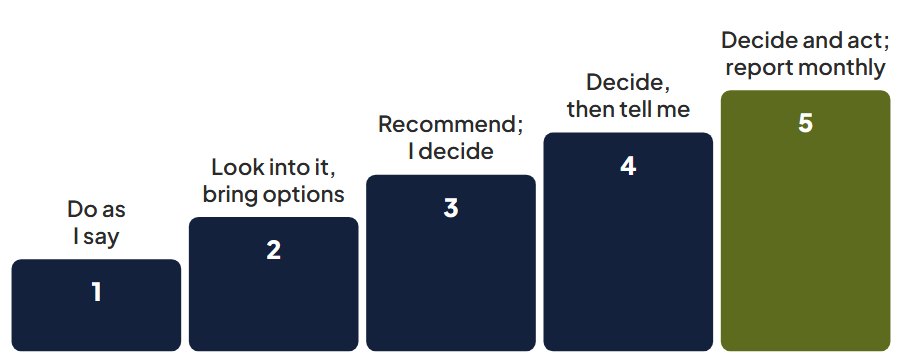
| Level | Who decides | Example (quotes) |
|---|---|---|
| 1 · Do as I say | You | “Send this price to the Pune pharma buyer today.” |
| 2 · Look into it | You, after options | “Find out what the job costs and give me two price options.” |
| 3 · Recommend | You, on their advice | “Work out the price you'd quote and tell me why.” |
| 4 · Decide, tell me | They do; you hear after | “Quote it; copy me on the email.” |
| 5 · Decide and act | They do | “Handle standard quotes; we'll review the month's numbers.” |
Choosing the level
The right level depends on the person's experience with this task and the risk if it goes wrong. It is not a judgement of the person in general: a senior manager can be at level 2 on something new.
| Low risk | Medium risk | High risk | |
|---|---|---|---|
| New to the task | Level 2 or 3 | Level 2 | Level 1 or 2 |
| Some experience | Level 4 | Level 3 | Level 2 or 3 |
| Done it well many times | Level 5 | Level 4 | Level 3 or 4 |
Say the level out loud
Most delegation disputes come from different assumptions about the level. The manager thought “recommend”; the team member thought “decide”. Say it in plain words every time.
How Ritesh moved up the levels
Sunil handed quote pricing to Ritesh, his sales manager, in stages over three months. At each stage they agreed what had to be true before moving up.
| Weeks | Level | What happened | To move up |
|---|---|---|---|
| 1–2 | 2 | Ritesh costed every quote and gave Sunil two price options | Costings match Sunil's in 9 of 10 cases |
| 3–6 | 3 | Ritesh recommended one price with reasons; Sunil decided | Sunil agrees with 80% of recommendations |
| 7–12 | 4 | Ritesh quoted directly within the margin floor; copied Sunil | No quote below 18% margin; weekly review clean |
| 13+ | 5 | Standard quotes handled fully; monthly review of numbers | — |
Moving up, and sometimes down
Levels are not permanent. Move people up as they show judgement. Occasionally you will need to move someone down for a while; do it openly and with a way back.
| Move up when | Move down (for a while) when |
|---|---|
| Their recommendations match yours most of the time | A serious mistake shows a gap in skill or understanding |
| They spot problems before you do | The situation changes: a new customer, a new law, a crisis |
| They ask fewer questions, and better ones | They are overloaded and asking for help |
| They have handled a difficult case well | They agree they need support |
Questions from the worksheet: Levels for your handovers
For each task you plan to hand over, choose the starting level and agree what will move the person up.
What to remember
- Five levels: do as I say, look into it, recommend, decide and tell me, decide and act.
- Choose the level by the person's experience with the task and the risk; start lower when unsure.
- Say the level out loud, agree what moves someone up, and review levels every quarter.
- Level of delegation
- How much freedom someone has to decide on a task.
- Recommend (level 3)
- They propose; you decide. The main training level.
- Escalate
- Bring a decision to a higher level because it is outside one's limits.
This article is adapted from the book. Examples marked “Example” use invented names and numbers; company stories are based on public sources listed in the book. For general learning; use your own judgement for your situation.

