Each section names the problem, the idea in one line, what you will be able to do, and the method from the book.
1. Where the money goes
The problem: You earn well but don't know where you stand.
You don’t need to track every rupee. Ten buckets, three months of statements and one honest evening show where the money goes and how much is really left.
By the end of the chapter you can:
- Sort a month’s spending into ten buckets in under an hour
- Work out your true savings rate
- Set up the ‘pay yourself first’ order of money
The ten buckets
Download three months of bank and card statements. Put each payment into one of these buckets, then average. Yearly payments (school fees, insurance, holidays) go in as one-twelfth a month.
| Bucket | What goes in it |
|---|---|
| 1 · Loan EMIs | Home, car, personal and education loans |
| 2 · Groceries and household | Food, supplies, repairs, society maintenance |
| 3 · Children | Fees, tuition, transport, activities |
| 4 · Home help | Cook, cleaner, driver, nanny |
| 5 · Utilities | Power, gas, water, phones, internet, subscriptions |
| 6 · Family support | Money sent to parents or relatives |
| 7 · Lifestyle | Eating out, shopping, entertainment, gifts |
| 8 · Travel | Holidays and trips, averaged over the year |
| 9 · Protection | Insurance premiums, averaged |
| 10 · Other | Everything that doesn’t fit; keep it under 5% |
2. The main types
The problem: You hold many funds and aren't sure why.
Each fund type does a different job. Match the type to the goal’s time and risk before you look at any fund’s returns.
By the end of the chapter you can:
- Place any fund in its category
- Match fund types to goals by time and risk
- Spot overlap and narrow bets in your own list
Equity funds and their categories
SEBI requires every scheme to sit in one defined category, and allows a fund house only one scheme per category (with a few exceptions such as index funds). Equity categories differ mainly by the size of the companies they may buy.
| Category | Mostly holds | Swings |
|---|---|---|
| Large cap | India’s 100 largest companies | Least of the equity funds |
| Large & mid cap | At least 35% each in large and mid-sized companies | Moderate |
| Mid cap | Companies ranked 101 to 250 by size | Higher |
| Small cap | Companies ranked 251 and below | Highest; long, deep falls are normal |
| Flexi cap / multi cap | Any size (multi cap: minimum in each size) | Depends on the mix |
| ELSS (tax saving) | Any equity; each investment locked for 3 years | Depends on the mix |
| Value, focused, dividend yield | A style or a short list of shares | Varies |
3. What a strong business looks like
The problem: You buy shares on tips and headlines.
Great long-term holdings tend to share three things: something that keeps competitors at bay, managers you can trust with your money, and room to keep growing.
By the end of the chapter you can:
- Name a company’s edge, or say honestly that it has none
- Judge management from what they do, not what they say
- Ask whether growth can continue
Five common kinds of edge
| Edge | What it looks like | Signs in the numbers |
|---|---|---|
| Brand | Customers pay more or choose it without thinking | Higher margins than rivals; steady prices |
| Low cost | Can sell cheaper and still earn well | Thin margins but high return on capital; growing share |
| Network | More users make it more useful for each user | Growth that speeds up as it gets bigger |
| Switching cost | Painful or risky for customers to change | Customers stay for years; steady repeat revenue |
| Licence or scale | Rules, permits or sheer size keep others out | Few competitors; stable share |
4. The four building blocks
The problem: Your money sits all in FDs, or all in one market.
Each asset class does a different job: equity grows, debt steadies, gold protects in some storms, property houses you. A good mix gives each a clear role.
By the end of the chapter you can:
- Describe each asset class’s role, return pattern and risks
- Decide whether your home belongs in the mix
- Give each part of your money a clear job
Equity: the growth engine
Over long periods, shares have been the main way households beat inflation by a wide margin, because they own the profits of growing businesses. The price is volatility: falls of 20–60% have happened several times in India’s market history.
| Strength | Weakness |
|---|---|
| Highest long-run growth of the four | Deep, sudden falls; years of going nowhere |
| Easy to buy and sell in small amounts | Easy to sell in panic |
| Profits grow with the economy | Needs years to smooth out |
5. Bank FDs and deposit insurance
The problem: You want safe money that still beats inflation.
Bank deposits are insured up to a limit per depositor per bank. Spread large sums so that the insured part covers most of your money, and choose banks with care.
By the end of the chapter you can:
- Explain what deposit insurance covers and what it doesn’t
- Spread deposits to stay within insured limits
- Choose FD types to suit income, access and tax
How FDs work
A fixed deposit lends your money to a bank for a set period at a set rate. You get interest paid out (monthly, quarterly) or added to the deposit (cumulative). At maturity you get the principal back, or renew.
| Choice | Options | Suits |
|---|---|---|
| Payout | Monthly, quarterly, or cumulative at maturity | Income needs vs growth |
| Term | From 7 days to 10 years | When you’ll need the money |
| Breakable? | Most can be broken with a penalty; some can’t | Emergency vs long-term money |
| Tax-saving FD | Locked for five years; may give a tax deduction under some regimes | Ask your CA first |
| Senior citizen FD | Banks usually pay a little extra to those 60+ | Parents |
| Sweep-in FD | Linked to savings; breaks automatically | Emergency funds |
6. Term life cover
The problem: You pay premiums but may still be under-covered.
Term cover should replace what your family would lose: future income for the years they depend on it, plus loans and big goals, minus what you already have.
By the end of the chapter you can:
- Work out a term cover amount with the needs method
- Choose the term, payout and riders sensibly
- Cover both partners, including a non-salaried one
Two ways to size cover
| Method | How | Strength | Weakness |
|---|---|---|---|
| Income multiple | 10–15 times yearly income | Quick | Ignores loans, goals, existing savings |
| Needs method | Income the family would lose + loans + goals − what you already have | Fits your family | Takes 20 minutes |
| Income multiple check, Arjun | |
|---|---|
| Take-home a year | About ₹25.8 lakh |
| 10–15 times | About ₹2.6–3.9 crore |
| Needs method (next pages) | About ₹2.23 crore |
7. Rent or buy
The problem: You're deciding whether to buy a home or a second flat.
Renting isn’t wasting money and buying isn’t automatically saving it. Compare the full costs of each, and what the renter can do with the money not tied up in a flat.
By the end of the chapter you can:
- Set up a fair rent-or-buy comparison
- Work out each side’s wealth after 10 years
- Know which assumptions decide the answer
What a buyer and a renter really pay
- Buyer’s start: down payment plus buying costs leave the family’s investments.
- Renter’s start: the same sum is invested instead.
- Each month: the buyer pays EMI plus maintenance; the renter pays rent and invests the difference (or draws on investments if rent is higher).
- After N years: buyer’s wealth = home value minus selling costs minus loan left; renter’s wealth = investments.
- Compare, and test different assumptions.
| Assumptions that matter most | Why |
|---|---|
| Price growth of the home | Drives the buyer’s result |
| Return on the renter’s investments | Drives the renter’s result |
| Rent as a % of price (rental yield) | Low yields favour renting |
| Loan rate | Higher rates favour renting |
| Years you’ll stay | Short stays favour renting (buying costs are large) |
8. The rupee
The problem: All your money is tied to one country and currency.
When you invest abroad, your return in rupees is the foreign return plus or minus the change in the exchange rate. Over long periods, a weaker rupee has added to Indian investors’ foreign returns.
By the end of the chapter you can:
- Work out a foreign return in rupees
- Explain the rupee’s long-run trend and short-run swings
- Match investments to the currency of your goals
What the rupee has done
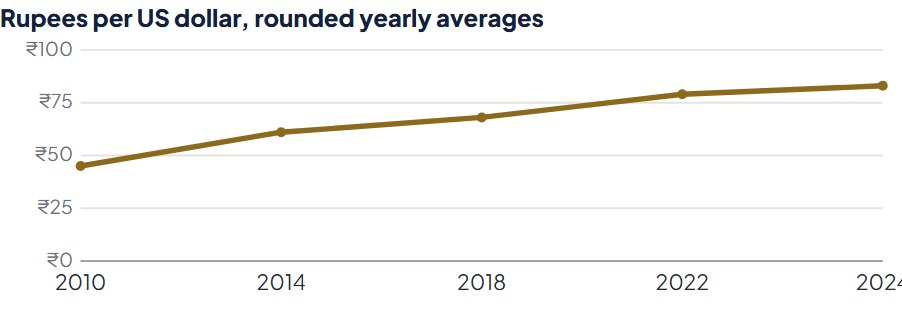
Over long periods the rupee has generally weakened against the US dollar, because India’s inflation has usually been higher than America’s. As a rough guide, the dollar went from about ₹45 in 2010 to about ₹83 in 2024: about 4.5% a year on average, with big swings within that.
9. Inflation and a long retirement
The problem: You don't know your retirement number.
Inflation doesn’t stop when you retire. Over 30 years at 6%, prices rise almost sixfold, so income that feels ample at 60 can feel thin at 80.
By the end of the chapter you can:
- Show inflation’s effect over a long retirement
- Estimate your personal inflation
- Plan for longevity, not average life expectancy
Your personal inflation
Official inflation measures an average basket. Retirees’ baskets are different: more health care, help at home and services, less education and gadgets.
| Cost | Tends to rise | Effect on a retiree |
|---|---|---|
| Health care, medicines | Faster than average | Larger share of spending with age |
| Domestic help and services | Faster (wages) | More needed in later years |
| Food | Around average | Steady share |
| Electronics, travel deals | Slower | Small share |
10. Loss aversion
The problem: Market falls make you want to sell.
Losses hurt more than equal gains please. That’s why falls feel unbearable and why people sell, or hold losers too long, against their own interest.
By the end of the chapter you can:
- Recognise loss aversion in your own decisions
- Tell paper losses from real ones
- Use reframing to stay steady
Paper losses and real losses
A fall in market value is a paper loss: the shares or units you own are still there. It becomes a real loss when you sell at the lower price, or if the business itself is damaged for good.
| Paper loss | Real loss | |
|---|---|---|
| What happened | Prices fell | You sold at the lower price, or the asset is permanently worse |
| Can it recover? | Yes, if the assets are sound and you hold | Only by investing again |
| Examples | An index fund down 25% in a crash | Selling in the crash; a company that went bust |
11. Nominee and legal heir
The problem: Your family wouldn't know what you own or how to claim it.
A nominee is the person an institution pays when you die. A legal heir is the person who’s entitled to your assets under your will or the law. Often they’re the same; when they aren’t, the difference matters.
By the end of the chapter you can:
- Explain what a nominee does and doesn’t get
- Know how heirs are decided without a will
- Align nominations with your will
When a nominee keeps the money
For most assets, the nominee is a custodian for the heirs. Life insurance has a special rule: under the insurance law, if the nominee is the policyholder’s parent, spouse or child (a ‘beneficial nominee’), they receive the money for themselves. Rules as of 2026; ask a lawyer about your case.
| Asset | Nominee usually… | Note |
|---|---|---|
| Bank deposits | Receives as a trustee for heirs | Up to four nominees allowed (2025 law) |
| Shares, demat, mutual funds | Receives as a trustee for heirs | Courts have confirmed this |
| Life insurance (spouse, child, parent nominee) | Keeps it as beneficial nominee | Insurance law rule |
| Life insurance (other nominee) | Receives for the heirs | |
| EPF | Rules under EPF scheme | Family members defined by the scheme |
This article is adapted from the book. Examples marked “Example” use invented names and numbers; company stories are based on public sources listed in the book. Education only: not investment, tax or legal advice.