Every fund comes in two plans with the same holdings and different costs. A gap of about 1% a year looks tiny and grows into lakhs.
Two plans, one portfolio
Since 2013, every Indian mutual fund scheme has had two plans. They hold exactly the same shares and bonds. The only difference is cost: a regular plan pays a commission to the distributor who sold it, every year, out of your money; a direct plan does not.
| Regular plan | Direct plan | |
|---|---|---|
| Portfolio | Same | Same |
| Fund manager | Same | Same |
| Commission to a distributor | Yes, every year, inside the expense ratio | No |
| Expense ratio | Higher | Lower |
| NAV | Lower over time | Higher over time |
| Where to buy | Distributor, bank, many platforms | Fund house, MF Central, many platforms, RIAs |
The expense ratio
The expense ratio (also called the total expense ratio, or TER) is the yearly cost of running a fund, taken out of the fund’s assets a little each day. You never see a bill; it simply lowers the NAV. SEBI sets maximum limits, which fall as a fund grows.
| What it pays for | Regular plan | Direct plan |
|---|---|---|
| Fund management and research | Yes | Yes |
| Operations, custody, registrar, audit | Yes | Yes |
| Distributor commission | Yes | No |
What 1% a year costs
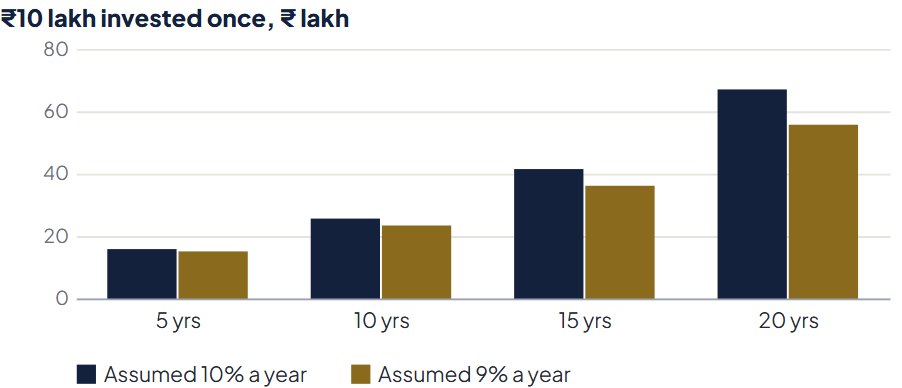
A 1% yearly gap sounds small. Over long periods it compounds against you, just as returns compound for you.
| After | At 10% | At 9% | Lost to the 1% gap |
|---|---|---|---|
| 10 years | ₹25.9 lakh | ₹23.7 lakh | ₹2.2 lakh |
| 20 years | ₹67.3 lakh | ₹56.0 lakh | ₹11.2 lakh (17% of the result) |
The Kulkarnis’ cost
All 14 of the Kulkarnis’ funds were regular plans. Comparing each with its direct plan, the average gap was about 1% a year.
Arjun’s first reaction was that the relationship manager had ‘cheated’ them. Neha pointed out that nobody had hidden anything: the expense ratios were published every month. They had simply never looked.
When paying for advice is worth it
Going direct saves money only if you can do what a good adviser would: choose sensibly, rebalance, and stay calm in a crash. If you will panic-sell in a fall, a good adviser can be worth far more than 1%.
| Who | How they’re paid | What to expect |
|---|---|---|
| Mutual fund distributor (ARN holder) | Commission inside regular plans | Help with forms and selection; not an adviser in law |
| Registered investment adviser (RIA) | A fee you pay directly; uses direct plans | Advice in your interest, a written plan |
| Bank relationship manager | Usually commissions, through the bank | Convenience; check for product pushing |
| Do it yourself | Nothing; direct plans | Your time, discipline and nerve |
Questions from the worksheet: Your plan costs
For each fund, find the expense ratio of both plans on the fund house’s website or factsheet.
What to remember
- Direct and regular plans hold the same portfolio; the regular plan costs more every year.
- A 1% yearly gap can take about 17% of the result over 20 years.
- Pay for advice only if you get real advice; check exit loads and tax before switching.
- Direct plan
- A fund plan bought without a distributor, with a lower expense ratio.
- Expense ratio (TER)
- The yearly cost of running a fund, taken from its assets.
- Exit load
- A fee for selling within a set period after buying.
This article is adapted from the book. Examples marked “Example” use invented names and numbers; company stories are based on public sources listed in the book. Education only: not investment, tax or legal advice.