
Break-even is the number of sales a month at which contribution exactly covers fixed costs. Work it out twice: once without your pay, and once with it.
The break-even sum
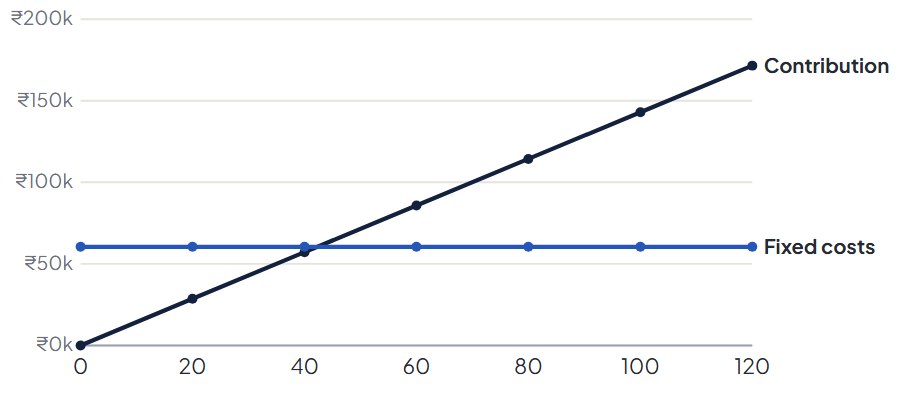
You already know two numbers: monthly fixed costs (Chapter 4) and contribution per sale (Chapter 3). Divide one by the other and you have your break-even: the sales a month needed to cover fixed costs.
Fixed costs a month → ÷ contribution per sale → = break-even sales a month
| Below break-even | At break-even | Above break-even |
|---|---|---|
| Each month loses money | No profit, no loss | Each extra sale adds its full contribution to profit |
| The buffer shrinks | The buffer holds | Profit builds |
Rohit's break-even
| Line | Amount |
|---|---|
| Fixed costs a month (own van) | ₹60,500 |
| Contribution per groom | ₹1,429 |
| Break-even: ₹60,500 ÷ ₹1,429 = 42.3 | 43 grooms a month |
| Working days a month | 24 |
| Break-even per working day | About 1.8 grooms |
Break-even with your pay
A business that only covers its own costs isn't paying you. Work out a second break-even that includes the pay you need, starting with your runway target from Book 1.
| Without Rohit's pay | With ₹80,000 a month for Rohit | |
|---|---|---|
| Fixed costs | ₹60,500 | ₹1,40,500 |
| Contribution per groom | ₹1,429 | ₹1,429 |
| Break-even grooms a month | 43 | 99 |
| Per working day (24 days) | About 1.8 | About 4.1 |
Rent or buy? Where one beats the other
Owning means high fixed costs and low variable costs; renting means the reverse. Break-even sums show where one becomes cheaper than the other.
| A month with 24 working days, 5 grooms a day | Own van | Rented van |
|---|---|---|
| Revenue (120 × ₹1,799) | ₹2,15,880 | ₹2,15,880 |
| Products (120 × ₹250) | ₹30,000 | ₹30,000 |
| Fuel | ₹14,400 | Included |
| Van and groomer | ₹60,500 | ₹1,44,000 (24 × ₹6,000) |
| Left before Rohit's pay | ₹1,10,980 | ₹41,880 |
Lowering your break-even
If break-even looks too high, there are only three levers. Try each before you give up on the idea.
| Lever | How | Watch out for |
|---|---|---|
| Raise contribution per sale | Higher price, lower variable cost, add-ons | Losing customers (test it, Book 3) |
| Cut fixed costs | Rent instead of buy, share space, part-time staff, used equipment | Capacity limits as you grow |
| Raise volume | More sales per day or per customer | Quality and staff burnout |
Questions from the worksheet: Your break-even
Work it out twice: without and with your own pay.
What to remember
- Break-even = fixed costs ÷ contribution per sale, rounded up; above it, each sale adds its whole contribution to profit.
- Work it out with your own pay too; that number decides whether the business can replace your salary.
- Lower it by raising contribution, cutting fixed costs or raising volume, and plan when you will reach it.
- Break-even
- Sales at which contribution equals fixed costs.
- Crossover
- The volume at which owning becomes cheaper than renting.
- Ramp
- How sales build month by month after launch.
This article is adapted from the book. Examples marked “Example” use invented names and numbers; company stories are based on public sources listed in the book. For general learning; use your own judgement for your situation.

