
Your runway is how many months your family can manage without your salary. Work it out honestly, and the leap stops being a gamble and becomes a plan.
What a runway is
A plane needs a runway long enough to reach take-off speed. A new business is the same: it needs enough months to start paying you before the money runs out. Your runway is the number of months your household can cover its spending without your salary, using only the money you have set aside for that purpose.
What the household spends → minus what still comes in → = the monthly gap → Runway money ÷ gap → = months of runway
Step 1: what the household really spends
Don't guess. Take the last three months of bank and card statements and add up what the household actually spent. Then spread yearly costs (school fees, insurance premiums, festivals, travel) over twelve months.
| Kavita's household, per month | Spent | After agreed cuts |
|---|---|---|
| Home-loan EMI | ₹42,000 | ₹42,000 |
| Groceries and household | ₹40,000 | ₹40,000 |
| School fees (yearly fees spread) | ₹18,000 | ₹18,000 |
| Support for parents | ₹12,000 | ₹12,000 |
| Insurance premiums (spread) | ₹7,000 | ₹7,000 |
| Car and transport | ₹11,000 | ₹11,000 |
| Utilities and phones | ₹8,000 | ₹8,000 |
| Eating out and leisure | ₹15,000 | ₹6,000 |
| Other | ₹12,000 | ₹7,000 |
| Total | ₹1,65,000 | ₹1,51,000 |
Step 2: what still comes in
Next, list every income that continues when your salary stops. Count only money you can rely on. A bonus that might come, or a property you might sell, is not income.
| Counts | Doesn't count |
|---|---|
| A spouse's or partner's take-home pay | Your expected business income |
| Rent from a property you own | A bonus or increment that is not yet confirmed |
| Regular interest you already receive and spend | Money from selling an asset |
| A pension that is paid to you | Help a relative “might” give |
Step 3: split your savings into three pots
Take only your liquid savings: money in savings accounts, fixed deposits and funds you could withdraw within days. Leave retirement and education money out entirely. Then split what you have into three pots, in this order.
- Pot 1, the emergency reserve. Six months of full household spending. Never used for the business or for the runway. It protects the family if something else goes wrong.
- Pot 2, the business budget. What the business may spend before it earns: set-up, tools, early costs. Book 4 shows how to estimate it.
- Pot 3, the runway fund. Everything left. It pays the household gap each month until the business pays you.
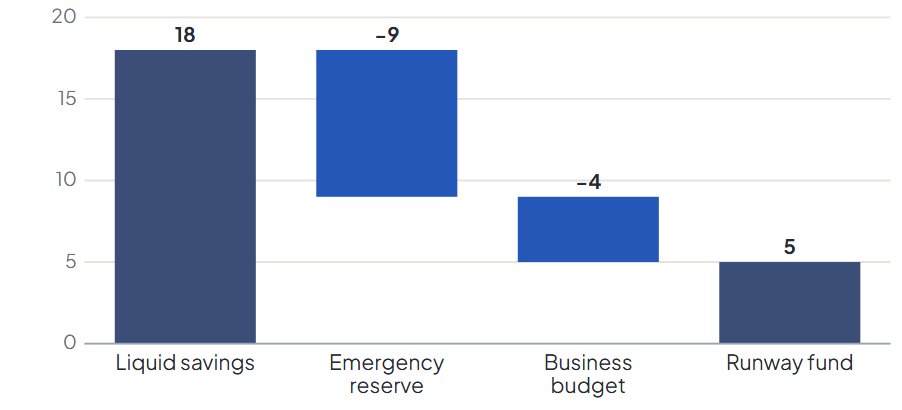
Kavita's 16 months
| If… | The runway becomes |
|---|---|
| The business pays Kavita ₹31,000 a month from month 6 | Only 5 months of the fund is used; it lasts indefinitely after that |
| Household spending creeps back up to ₹1,65,000 | ₹5,00,000 ÷ ₹45,000 = 11 months |
| They didn't make the cuts | Also 11 months: the cuts are worth 5 months of runway |
| Suresh's pay rises by ₹10,000 | ₹5,00,000 ÷ ₹21,000 = 23.8, about 24 months |
Questions from the worksheet: Your runway
Use your last three months of statements. The Excel runway calculator does the same sums.
What to remember
- Runway = the runway fund ÷ the monthly gap between household spending and the income that continues.
- Split liquid savings into an untouchable emergency reserve, a business budget and the runway fund.
- Agree the numbers, cuts, review dates and stop rule with your family before you resign.
- Runway
- Months the household can manage without your salary.
- Monthly gap
- Household spending minus income that continues.
- Emergency reserve
- Six months of spending, never used for the business.
This article is adapted from the book. Examples marked “Example” use invented names and numbers; company stories are based on public sources listed in the book. For general learning; use your own judgement for your situation.

