The cash cycle is the number of days your money is stuck between paying for materials and being paid by customers. Every day you cut frees cash; every day you add costs it.
The cycle in one picture
Picture one batch of goods. You buy materials, and your supplier gives you some days to pay. The materials sit in stock or in production, then go out to a customer, who takes more days to pay you. The gap between the day you pay your supplier and the day your customer pays you is your cash cycle.
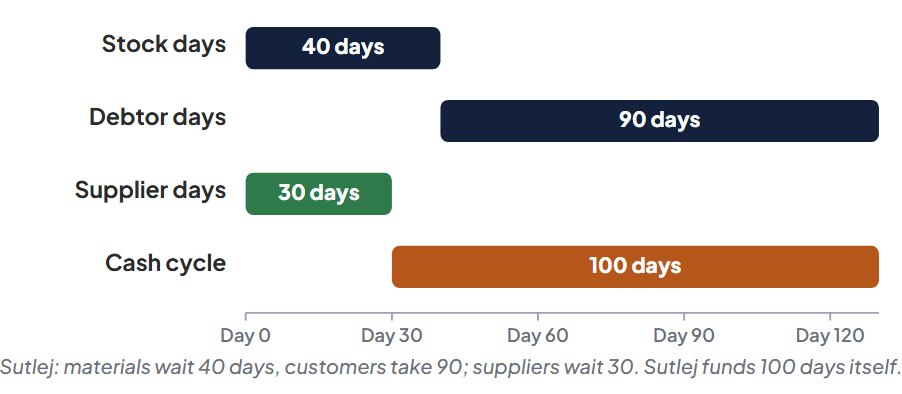
For those 100 days, the money is Sutlej's own or the bank's. Double the sales and you need roughly double the money tied up in the cycle. Shorten the cycle and the same sales need less.
Working out your days
You need four figures from your accounts: yearly sales, yearly purchases (or cost of goods), and the closing balances of stock, debtors and suppliers. Use averages if your balances swing through the year.
| Days | Formula | Sutlej |
|---|---|---|
| Debtor days | Debtors ÷ yearly sales × 365 | ₹296 lakh ÷ ₹1,200 lakh × 365 = 90 |
| Stock days | Stock ÷ yearly materials and other direct costs × 365 | ₹72 lakh ÷ ₹660 lakh × 365 = 40 |
| Supplier days | Suppliers ÷ yearly purchases × 365 | ₹54 lakh ÷ ₹660 lakh × 365 = 30 |
| Cash cycle | Stock days + debtor days − supplier days | 40 + 90 − 30 = 100 days |
What one day is worth
Each day of the cash cycle has a price in rupees. Knowing it turns a vague goal (“collect faster”) into a target with a value.
| Sutlej | Per day | Basis |
|---|---|---|
| One day of sales | ₹3.3 lakh | ₹1,200 lakh ÷ 365 |
| One day of materials | ₹1.8 lakh | ₹660 lakh ÷ 365 |

Sutlej's 100 days
Harpreet split her debtor days by customer. The average of 90 hid a wide spread.
| Customer | Yearly sales | Days to pay | Owed now |
|---|---|---|---|
| Tractor maker A | ₹4.8 crore | 75 | ₹99 lakh |
| Two-wheeler maker B | ₹3.6 crore | 110 | ₹1.08 crore |
| Tier-1 supplier C | ₹2.0 crore | 95 | ₹52 lakh |
| Twelve smaller buyers | ₹1.6 crore | 85 | ₹37 lakh |
| Total | ₹12.0 crore | 90 | ₹2.96 crore |
Customer B paid in 110 days against agreed terms of 75. Bringing B alone to its agreed terms would free about ₹35 lakh (35 days × ₹1 lakh of B's sales a day).
Which days to shorten first
All three parts of the cycle can be shortened, but they differ in how much cash they free, how fast, and what they cost in goodwill.
| Lever | Typical actions | Speed | Watch out for |
|---|---|---|---|
| Debtor days | Clean invoices, follow-up rhythm, credit limits, advances on big orders | Weeks | Losing customers if you push too hard |
| Stock days | Clear slow stock, smaller and more frequent orders, reorder levels | Weeks to months | Running out of fast-moving items |
| Supplier days | Agree longer terms, consolidate suppliers, pay on the due date | Immediate | Damaging supply; harming small suppliers |
| Order terms | Advances or milestone payments on large or custom orders | Next order | Competitors who do not ask |
Questions from the worksheet: Your cash cycle
Work out your days, then the cash each change would free.
Columns in the worksheet: Item · Figure · Days · Cash freed by the change
What to remember
- Cash cycle = stock days + debtor days − supplier days.
- Each day of the cycle is worth one day of sales or purchases in cash.
- Shorten debtors first; never fund yourself only by stretching suppliers.
- Debtor days
- How long customers take to pay, on average.
- Stock days
- How long materials and goods wait before they are sold.
- Supplier days
- How long you take to pay suppliers.
This article is adapted from the book. Examples marked “Example” use invented names and numbers; company stories are based on public sources listed in the book. Education only: not investment, tax or legal advice.