Collections work when they follow a steady, polite rhythm that every customer can predict. Random chasing gets random results.
The rhythm
Customers pay the suppliers who are predictable. A rhythm tells them exactly what will happen if a payment is late, and it tells your team exactly what to do each day.
| When | Action | Who |
|---|---|---|
| 7 days before due | Friendly reminder with invoice copy; confirm acceptance | Accounts |
| On the due date | “Due today” message | Accounts |
| 3 days overdue | Phone call: when will it be paid? | Accounts |
| 15 days overdue | Call from the sales head; note the promise | Sales head |
| 30 days overdue | Owner calls the customer's owner or finance head; new orders need approval | Owner |
| 45 days overdue | Supply on hold; written reminder of terms and rights | Owner |
| 60 days overdue | Formal notice; consider legal and other remedies (Chapters 5 and 6) | Owner, with adviser |
What to say: reminders
Keep reminders short, polite and specific. Always name the invoice, the amount and the date. Your toolkit has these as ready-to-copy messages.
The collection call
A good collection call is short and ends with a specific promise. Plan it before you dial.
- Prepare. Invoices, amounts, due dates, past promises, the right person's name.
- Be polite and direct. “I'm calling about invoices 1184 and 1192, ₹6.1 lakh, now 18 days overdue.”
- Ask an open question, then listen. “What is holding them up?” The answer tells you what to fix.
- Get a specific promise. Amount, date and how it will be paid. “This week” is not a promise; “₹6.1 lakh by RTGS on Thursday” is.
- Confirm in writing. A short email the same day repeating the promise.
- Follow up the day after the promised date. Kept: thank them. Broken: escalate one step.
Escalation without burning bridges
Most customers who pay late are not acting in bad faith. Escalation should increase pressure step by step, while keeping the door open for the relationship.
| Step | Tone | What it signals |
|---|---|---|
| Accounts reminders and calls | Friendly, routine | We keep track of every invoice |
| Sales head or relationship manager | Concerned, helpful | This is now a relationship issue |
| Owner to owner, or to finance head | Firm, respectful | This matters at the top of our business |
| Supply on hold | Factual, regretful | Terms apply to everyone |
| Formal notice | Formal | We will use our legal rights if needed |
Pristine's new rhythm
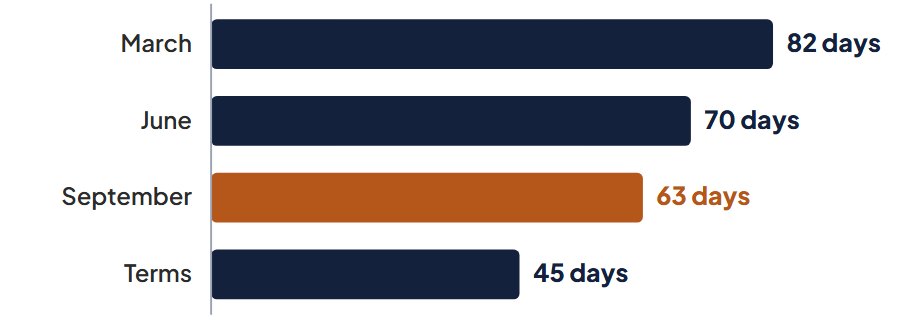
Nirav put the rhythm in place in April, with one accounts assistant spending her mornings on collections. Sales staff were told that customers over 45 days would be on hold, without exceptions unless he approved them.
| Pristine Pack | March | June | September |
|---|---|---|---|
| Debtor days | 82 | 70 | 63 |
| Overdue as a share of debtors | 45% | 33% | 24% |
| Over 60 days overdue | ₹36 lakh | ₹24 lakh | ₹14 lakh |
| Customers put on hold | – | 7 | 3 |
Questions from the worksheet: Your rhythm
Set your own steps. Name the person responsible and the words they will use.
Columns in the worksheet: When · Action · Who · Channel
What to remember
- A predictable rhythm, starting before the due date, gets customers to pay you first.
- Every call ends with a specific promise, confirmed in writing and followed up.
- Escalate step by step; make supply-on-hold real and consistent.
- Follow-up rhythm
- Fixed steps from before the due date to formal action.
- Promise to pay
- A specific amount, date and method agreed by the customer.
- Supply on hold
- Stopping new deliveries while an account is overdue.
This article is adapted from the book. Examples marked “Example” use invented names and numbers; company stories are based on public sources listed in the book. Education only: not investment, tax or legal advice.