Franklin Templeton, April 2020
On 23 April 2020, a month into India’s Covid lockdown, Franklin Templeton Mutual Fund announced that it was winding up six of its debt schemes. Together they held about ₹25,000 crore (reports give ₹25,215 to ₹25,800 crore). The fund house said redemption requests had risen sharply while the market for the bonds these schemes held had dried up, so it could not sell them to pay investors without large losses.
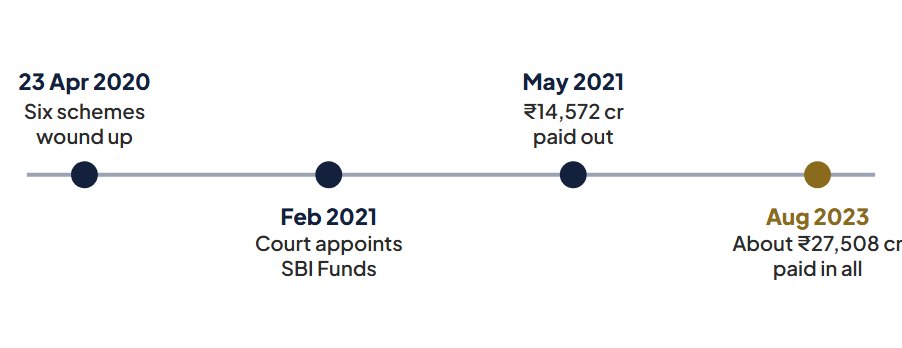
Investors’ money was frozen. The Supreme Court appointed SBI Funds Management in February 2021 to oversee the sale of the assets. Payments came in stages: about ₹14,572 crore by May 2021, and about ₹27,508 crore by August 2023, about 9% more than the value of the holdings on the day of winding up.
What the story teaches
In the end, investors got back more than the holdings were worth on the day the schemes closed. But many waited up to three years for money they had thought of as safe and quick, some of it meant for near-term needs.
- A label is not the risk. Several of the schemes had ‘short term’ or ‘low duration’ in their names. What mattered was what they held, and how easily it could be sold.
- Higher yield had a reason. Debt funds that earn more than their peers usually hold lower-rated or harder-to-sell papers. The factsheet shows this.
- Liquidity matters in a crisis. Debt that is easy to sell in calm markets may not be in a panic.
- Spread safe money too. Emergency and near-term money is best split across deposits and the safest fund types (overnight, liquid, gilt).
Chapter 6: Read a factsheet
Every fund publishes a monthly factsheet. Ten numbers on it tell you what the fund holds, how it behaves and what it costs, far more than its last year’s return.
- Find the ten numbers that matter on any factsheet
- Read a debt fund’s risk from its holdings
- Spot a fund that has drifted from its label
This article is adapted from the book. Examples marked “Example” use invented names and numbers; company stories are based on public sources listed in the book. Education only: not investment, tax or legal advice.