
Education only. Not investment advice.ProShelf is not registered with SEBI as an investment adviser or research analyst. These books give no tips, calls or recommendations to buy or sell anything. Charts use invented example data or past events at least three months old. Trading, especially futures and options, can lose you money: SEBI's own studies found that about 9 in 10 individual F&O traders made losses (FY22–FY24).
In a pump-and-dump, people connected to a scheme push up a thinly traded share, promote it to the public, and sell to the buyers they attract. When the selling ends, the price collapses.
The four stages
| Stage | What the scheme does | What the public sees |
|---|---|---|
| Accumulate | Buys quietly in a thinly traded share | Nothing much |
| Push | Trades between connected accounts to lift price and volume | A steady rise, rising volume |
| Promote | Videos, messages, ‘news’, targets, fake reports | Excitement, upper circuits, tips everywhere |
| Dump | Sells to the new buyers at high prices | Price stalls, then falls, often in lower circuits |
What it looks like on a chart
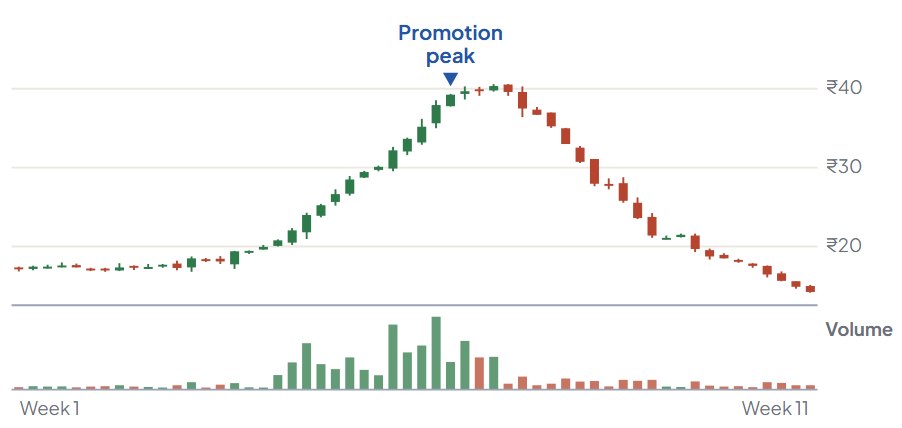
Example (invented): Vindhyachal Agro, a small share normally trading about ₹3 lakh a day, rises from about ₹18 to ₹41 in five weeks on volume up to ten times normal, then falls to about ₹14.
| Chart sign | Why it matters |
|---|---|
| Steep rise with no company news | Demand coming from somewhere other than the business |
| Volume many times normal in a thin share | New buyers arriving, often from promotion |
| Repeated upper circuits | Small supply, eager buyers; exits will be just as hard |
| High volume with little progress at the top | Distribution: sellers meeting the crowd (Book 6) |
Why late buyers lose most
| Problem for late buyers | Why |
|---|---|
| Bought near the top | Promotion peaks when the scheme wants to sell |
| Cannot get out | Lower circuits, few buyers, wide spreads (Book 1, Chapter 6) |
| Hold in hope | Anchoring to the buying price and the ‘target’ (Book 9) |
| Average down | Adding to the share the scheme is leaving (Book 3) |
Spotting one early
| Check | Warning sign |
|---|---|
| Size and liquidity | Small company; normal trading of a few lakh rupees a day |
| Company announcements | Big claims in messages, nothing on the exchange website |
| Price and volume | Steep rise, many times normal volume, repeated upper circuits |
| Exchange surveillance | The share under a surveillance measure or price band change (Book 1, Chapter 6) |
| Who is promoting | Unregistered channels, groups, ‘analysts’ with targets |
| Pressure | ‘Buy before Monday’, ‘last chance’, ‘operators are entering’ |
Questions from the worksheet: Check a hot share
Before buying any small share someone recommends, fill in this row. Any ‘bad’ answer is a reason to stop.
What to remember
- Pump-and-dumps accumulate, push, promote and dump a thin share; the public is the exit.
- In the Sadhna Broadcast case, SEBI found false video claims and connected trading; 59 were barred in 2025.
- Big claims with no exchange announcement, volume spikes and pressure are reasons not to buy.
- Pump-and-dump
- Raising a price artificially, then selling to the buyers attracted.
- Connected trades
- Trades between related parties that create a false picture of demand.
- Corporate announcement
- Official company news filed with the stock exchanges.
This article is adapted from the book. Examples marked “Example” use invented names and numbers; company stories are based on public sources listed in the book. Education only: not investment, tax or legal advice.

