
Every trade pays a toll: the visible charges on the contract note and the invisible ones in the spread and the fill. Small tolls, paid often, decide whether active trading can pay at all.
The visible charges on a contract note
Your contract note lists each charge separately. Names and rates vary by broker and change over time; the types stay the same.
| Charge | Who sets it | What it is |
|---|---|---|
| Brokerage | Your broker | The broker's fee; flat per order or a percentage |
| Securities transaction tax (STT) | The government | A tax on the value of each trade; differs for delivery, intraday and derivatives |
| Exchange transaction charges | The exchange | A small percentage of value |
| SEBI turnover fee | SEBI | A very small percentage of value |
| Stamp duty | The government (states) | On the buyer's side only |
| GST | The government | On brokerage and exchange charges, not on the trade value |
| Depository charge | Depository and DP | A flat fee each time shares leave your demat on a sale |
Anita's round trip, line by line
Illustrative rate card (invented): brokerage ₹20 an order; STT 0.1% of value on each side; exchange and SEBI charges 0.004%; stamp duty 0.015% on buys; GST 18% on brokerage and exchange charges; ₹15 depository charge on each sell.
| Item | Buy 40 at ₹482.00 | Sell 40 at ₹510.00 |
|---|---|---|
| Trade value | ₹19,280.00 | ₹20,400.00 |
| Brokerage | ₹20.00 | ₹20.00 |
| STT | ₹19.28 | ₹20.40 |
| Exchange and SEBI charges | ₹0.77 | ₹0.82 |
| Stamp duty | ₹2.89 | – |
| GST | ₹3.74 | ₹3.75 |
| Depository charge | – | ₹15.00 |
| Total charges | ₹46.68 | ₹59.96 |
The invisible costs: spread, slippage and impact
Some costs never appear on the contract note because they are inside the price you got.
| Cost | What it is | Anita's example |
|---|---|---|
| Spread | Buying at the offer and selling at the bid | ₹0.10 a share in Kaveri Textiles; ₹1.20 in a thin share |
| Slippage | The gap between the price you planned and the price you got | Her AMO filled at ₹497.30 after a ₹482 close |
| Impact | Your own order moving the price | Tiny for 40 shares; large for ₹5 lakh of a small share |
| Interest | On margin positions, every day you hold | None: she pays in full |
Why frequent trading is expensive
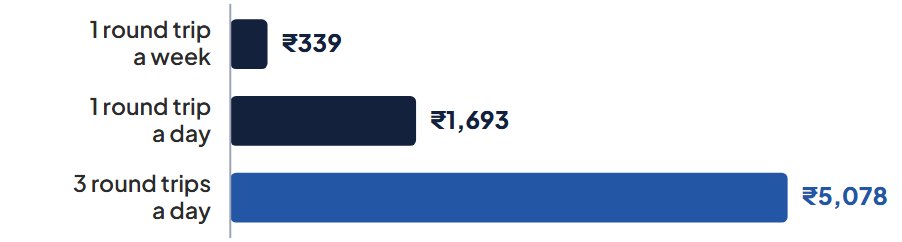
A cost of a few tenths of a percent per round trip is easy to ignore once. Repeated daily, it becomes a large hurdle that has to be beaten before you make anything.
Check your contract note
Once a month, pick one contract note and check it line by line. It takes five minutes and catches errors and trades you did not place.
- Trades. Every line matches an order you placed: share, quantity, price, buy or sell.
- Charges. Brokerage matches the broker's published plan; statutory charges are in the usual range.
- Net amount. The amount payable or receivable matches the movement in your trading account.
- Anything odd. A trade you did not place: report it to the broker the same day, in writing.
Questions from the worksheet: The full cost of your last trade
Take one completed round trip (buy and sell). Fill in every cost, visible and invisible.
What to remember
- Contract notes show brokerage, STT, exchange and SEBI charges, stamp duty, GST and depository fees.
- Spread, slippage and impact are hidden in the price and are often bigger than brokerage.
- Frequent trading turns small costs into a large monthly hurdle.
- Contract note
- The legal record of a day's trades and charges.
- Slippage
- The difference between the planned and the actual fill price.
- Round trip
- A buy and the matching sell (or the reverse).
This article is adapted from the book. Examples marked “Example” use invented names and numbers; company stories are based on public sources listed in the book. Education only: not investment, tax or legal advice.

